Insights, updates and stories about people, data, and the future of work.
Symplio Team9 September 2026
No Consultants. No Implementation Projects. Just Get Started.
Traditional workforce management software can come with a long implementation process.
Consultants
Training sessions
Configuration projects
Extra implementation fees
We think there should be a simpler way.
That’s why we built Symplio.
With guided onboarding you can get started on your own, without outside help.
Guided onboarding, supported by AI
Symplio uses guided onboarding and AI to help you set up your workspace, configure your team and start managing schedules and working hours without needing a consultant.
The platform guides you through the important steps, while AI helps answer questions and get you moving when you need assistance.
And when you want to speak to a real person?
Our support team is there for you.
No expensive implementation project. No consultant fees. No weeks of waiting before you can start.
Just sign up, follow the guidance, invite your team and get to work.
Because workforce management software should work for your business, not become another project your business has to manage.
Symplio Team19 August 2026
Time tracking is becoming essential: what does the EU obligation mean for employers?
Time tracking has long stopped being just an administrative tool for logging hours. Because of European legislation and case law, it is becoming increasingly important for employers to have demonstrable insight into the hours actually worked.
But how exactly does that obligation work? And what does it mean for small and medium-sized businesses in Europe?
The basics: European working time rules
The EU sets the framework; member states decide on implementation.
The European Working Time Directive (2003/88/EC) sets minimum rules for daily and weekly rest and for the maximum average weekly working time, among other things. The goal is clear: employees must be protected against excessive working hours and insufficient rest.
An important part of that is that employers and regulators must be able to verify how much work is actually being done.
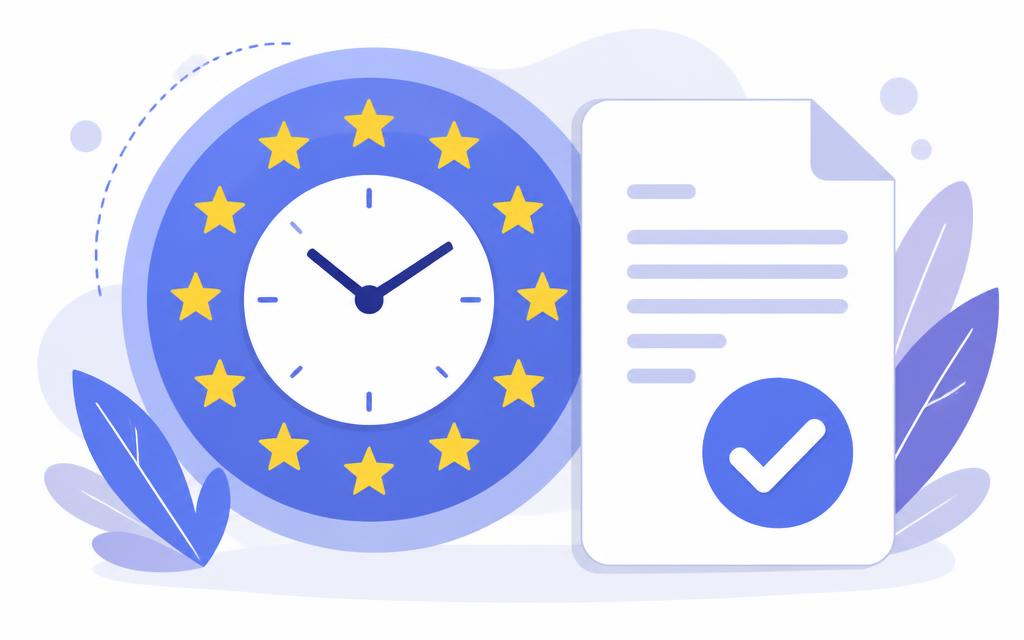
The European Commission has laid these rules down in the Working Time Directive.
The landmark European ruling of 2019
A major turning point came in 2019 with the CCOO v. Deutsche Bank ruling (C-55/18) of the Court of Justice of the European Union, brought by a Spanish trade union.
The Court ruled that member states must require employers to have a system that measures the daily working time of every employee.
Such a system must be objective, reliable and accessible.
The reasoning is simple: without reliable records it is hard to establish whether employees actually get enough rest and whether maximum working time is respected.
Does that mean the same obligation applies everywhere?
No. And that distinction matters.
The EU sets the legal framework, but the concrete implementation is largely left to the individual member states. The Court of Justice explicitly stated that member states may decide how the recording system is set up, taking into account the sector and certain characteristics of companies.
As a result, the precise obligations can differ between, for example, the Netherlands, Portugal, Spain, Germany and other European countries.
What is becoming ever clearer is the underlying European principle: employers must be able to record the time actually worked in a reliable way.
From punch clock to digital time tracking
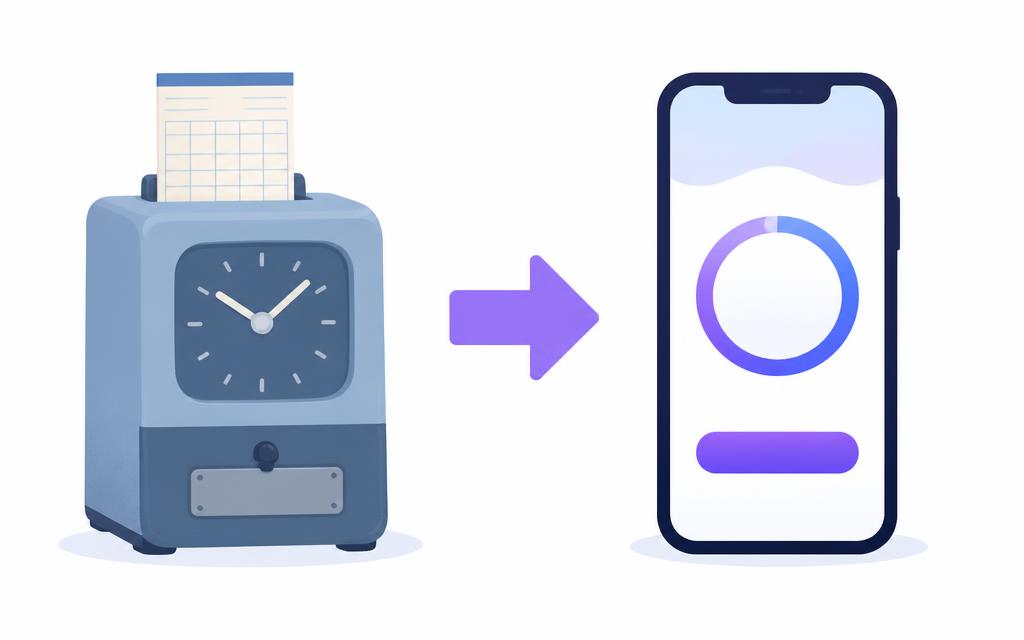
From punch clocks and spreadsheets to tracking in your pocket.
Time tracking used to mean a punch clock or a spreadsheet. Today, more and more organisations work with digital systems.
A modern time tracking system can automatically record, for example:
when an employee starts and stops;
how many hours were actually worked;
breaks and rest periods;
overtime;
deviations from the schedule;
hours per location, project or activity;
leave and absence.
That turns time tracking into more than legal record keeping — it becomes a practical tool for employers.
Why this matters especially for smaller businesses
With 5, 10 or 20 employees the records still have to add up.
For large organisations, extensive HR administration is usually already part of daily operations. In a company with 5, 10 or 20 employees, time tracking can easily end up in loose spreadsheets, WhatsApp messages or manual notes.
That causes problems when you later have to establish how much someone actually worked.
A digital system makes sure the record starts with the employee and stays centrally available to the employer.
Time tracking as part of being a good employer
The European rules exist first and foremost to protect employees. Reliable records therefore help employers not only to comply, but also to give clarity to their people.
Everyone can see:
When did I start? How much did I work? Did I build up overtime? And is my recorded time correct?
That makes discussions about worked hours a lot easier.
What does this mean for employers?
The key message is that time tracking can less and less be treated as an optional administrative choice.
With the Working Time Directive and the case law of the Court of Justice, the EU has given a clear direction: time actually worked must be establishable in an objective, reliable and accessible way.
The exact obligations differ per country. Employers are therefore wise to look not only at local legislation, but also at how their current record keeping works in practice.
Ready for modern time tracking?
With Symplio, small and medium-sized businesses can organise their time tracking digitally with ease. Employees clock in and out on their smartphone or a kiosk, while employers get real-time insight into worked hours, scheduling, overtime and attendance.
That way time tracking stops being complicated administration and becomes a simple part of the daily workflow.
More insight. Less administration.
Reliable time tracking.
Symplio TeamArticle
Why numbers alone aren't enough: the power of factual data and personal energy levels
Within modern organisations, more and more work is being done with data. This helps companies gain better insight into processes, planning and administration. Think of time tracking, contract details, leave and attendance.
These details are valuable, but they mainly show what is happening.
The human side remains just as important. That's why Symplio introduces the energy check: a simple way for employees to voluntarily share their personal energy level and thereby create room for a conversation.
Data provides insight, people give meaning
Factual data forms the basis of many business processes. It helps organisations stay in control and make better decisions.
Examples of factual data:
hours worked
contractual agreements
leave registration
attendance
planning
But behind every employee is an individual. Two employees can work the same hours and have a totally different experience.
The energy check: a voluntary moment of reflection
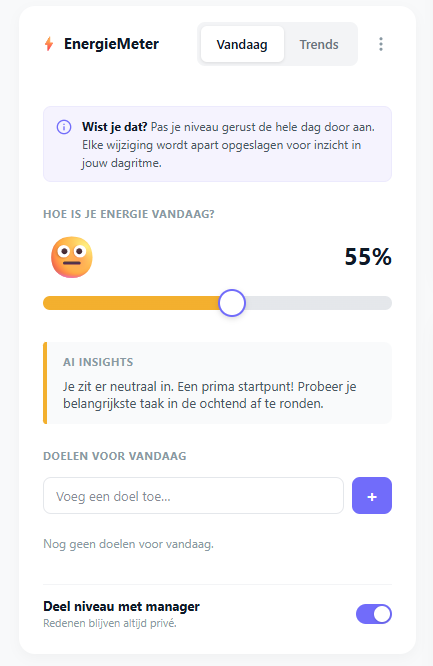
The personal EnergyMeter in Symplio.
The energy check within Symplio is not about collecting personal information or judging employees.
It is purely about the personal energy level that an employee chooses to share. The energy check simply gives employees the option to send a signal when they want to.
From data to dialogue
An important difference between traditional dashboards and the energy check is the way the information is used.
The aim is not to draw automatic conclusions. An energy level is not a diagnosis, not a judgement and not an explanation. It can only be a reason for a human conversation.
For example:
"You've indicated that your energy level is different from usual. Would you like to share something about it?"
The employee then decides for themselves whether and how much they want to discuss.
An organisational culture where conversations become easier
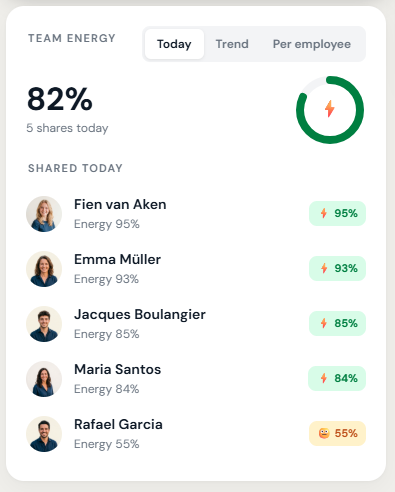
The Team Energy overview for managers.
In many organisations, conversations only arise when there is already a clear reason. Symplio helps make communication more accessible.
By combining factual data with voluntarily shared insights, a more complete picture of the organisation emerges — without monitoring employees.
It is not about measuring more. It is about listening better.
The future of work: technology that supports conversations
Technology can help organisations become smarter. But the best systems ultimately support the people within an organisation.
Symplio's energy check is designed with one goal: to help employees and organisations talk to each other earlier, more simply and more humanely.
Because the value of data isn't only in the numbers.
The real value emerges when numbers lead to connection.